The Inverted Hierarchy
Moving Authority Closer to Value
Executive Summary: The inverted hierarchy positions decision authority closer to employees creating customer, operational, financial value. Leadership provides the information, development, accessible expertise, accountability required for informed action. The Point-of-Value Architecture translates the principle into practical implementation, team alignment, measurable business progress.
Frontline decisions shape the bottom line.
Titles communicate responsibility. Reporting relationships establish accountability. Executives carry enterprise authority. Managers translate strategy into execution. Frontline employees bring organizational commitments into direct contact with customers, patients, clients, operations, service delivery.
Formal rank represents one dimension of organizational responsibility. Proximity to value represents another.
During a single interaction, an early-career employee can influence customer trust, purchasing decisions, relationship continuity, brand reputation.
Operations employees may identify quality concerns before financial exposure expands.
Service professionals can recognize emerging expectations before patterns appear in performance data.
Sales representatives may hear objections revealing market opportunities.
Each role carries organizational consequence.
The inverted hierarchy begins with a leadership question:
How effectively does the organization equip employees closest to value creation?
For CEOs, business owners, HR directors, the answer carries strategic significance. Decisions about development, information access, recognition, managerial support, delegated authority influence the conditions under which employees deliver results.
The inverted hierarchy positions leadership resources around consequential work. Executives establish direction. Managers develop judgment. Specialists provide expertise. Employees receive defined authority proportionate to their responsibilities.
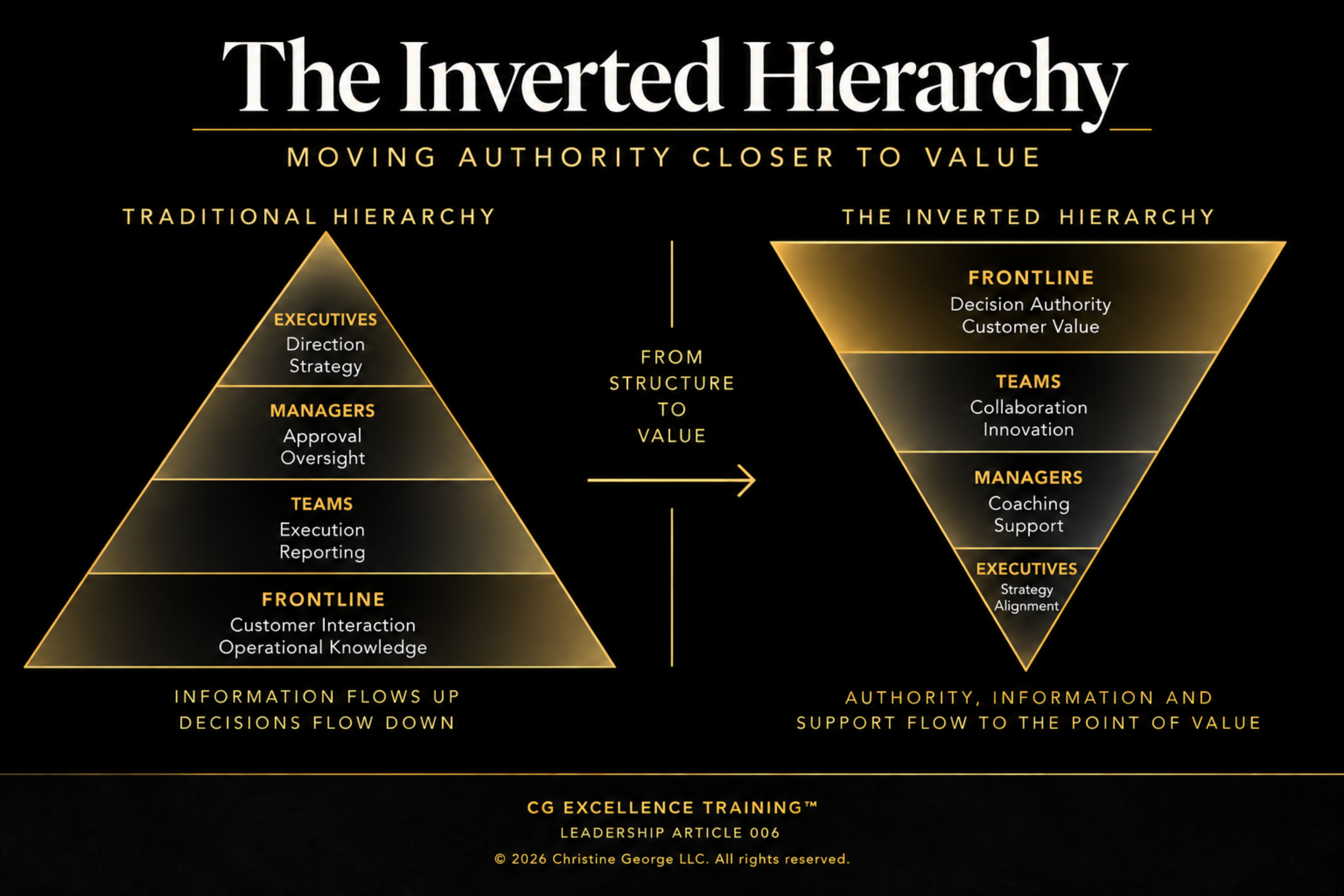
Figure 1. Traditional hierarchy coordinates enterprise responsibility through established reporting relationships. A point-of-value architecture complements formal structure by positioning defined authority, relevant information, leadership support, and accountability closer to employees creating or protecting customer, operational, and financial value.
Frontline | High Stakes
Placing an employee directly in front of a customer represents a significant act of organizational trust.
The employee assumes responsibility for translating a promise into an experience. Product knowledge, professional discretion, timely action, ownership of resolution can influence the commercial outcome. Preparation for customer-facing work therefore deserves attention commensurate with the value entrusted to the role.
Comparable responsibility exists throughout the enterprise.
Production employees protect quality, capacity, cost discipline.
Healthcare professionals influence patient experience, care coordination, safety.
Logistics teams protect continuity, delivery performance, customer confidence.
Field employees uphold brand standards across locations.
Administrative professionals connect customers with essential information, services, internal expertise.
Sales professionals convert market intelligence into commercial opportunities.
A practical leadership question follows:
How much organizational value is entrusted to the role?
Formal hierarchy organizes reporting scope, decision authority, compensation, accountability. A point-of-value view adds the significance of the decisions employees encounter.
Recognizing role significance gives executives a practical basis for allocating development resources. Investment can reflect customer exposure, operational complexity, required discretion, potential business impact.
Frontline Intelligence Requires an Operating Pathway
Employees closest to daily execution encounter early signals of changing conditions. Customer questions reveal expectations. Recurring workarounds expose process friction. Quality observations identify opportunities for intervention. Service patterns suggest improvements deserving broader attention.
Research from Eagle Hill Consulting, conducted by Ipsos among 1,375 U.S. employees, found 78% regularly exchanged efficiency ideas with colleagues. Sixty-six percent had shared ideas with their organization.
Employees reporting a clear organizational process for ideas were approximately three times as likely to describe their organization as effective at improving productivity: 44% compared with 15%. The findings reflect employee assessments of organizational effectiveness.
For executives, the practical implication concerns the route from insight to action.
A credible process gives observations an owner, establishes evaluation criteria, communicates decisions, tracks implementation. Employees can see how their contributions inform operating improvements. Management gains access to knowledge generated through direct experience.
Frontline intelligence becomes useful enterprise knowledge through disciplined follow-through.
Management Attention Drives Performance
Organizational structure influences how professional value is interpreted.
Titles, educational requirements, compensation bands, reporting relationships can shape access to executive attention, coaching, development, discretion. A point-of-value review invites leadership to examine how those practices relate to the responsibility carried by each role.
The central question becomes:
Do management practices reflect the business significance of the work?
The answer appears in everyday operating conditions:
Employees understand the commercial purpose behind their responsibilities.
Development addresses the decisions they regularly encounter.
Current information is available during time-sensitive interactions.
Managers coach professional judgment.
Recognition reflects insight, sound discretion, meaningful improvement.
Expertise is accessible when coordination or escalation becomes appropriate.
Professional regard becomes tangible through resource allocation. Budget decisions, manager availability, learning priorities, information access communicate the significance an organization assigns to frontline contribution.
Decision Authority as an Operating Asset
Defined authority enables employees to act on relevant knowledge.
Research published in Econometrica by Namrata Kala examined a natural experiment involving Indian state-owned enterprises receiving greater managerial autonomy over strategic decisions. Expanded authority produced greater value added. The research also identified changes in organizational priorities, including reduced provision of employee housing alongside increased markups.
The study concerns managerial autonomy within a specific institutional setting. Its findings invite a broader executive consideration: delegation influences the outcomes decision-makers pursue.
The implication for organizational design is to align discretion with explicit objectives, stakeholder responsibilities, performance measures. Governance gives delegated authority a clear purpose.
Decision placement also requires attention to scope. Enterprise-wide commitments call for coordinated executive oversight. Local improvements, service recovery, reversible actions, customer-specific judgments may benefit from authority near the work.
Proximity supplies context. Competence supports interpretation. Decision boundaries clarify responsibility. Review practices create learning.
Position authority where knowledge, capability, accountability, consequence align.
The Manager as Multiplier
Managers make the inverted hierarchy operational.
They translate priorities into practical clarity, develop judgment, coach problem-solving, connect employees with expertise. Their proximity to daily execution also enables recurring observations to reach executives with useful context.
Gallup reported growth in the average span of control for U.S. managers, from 10.9 employees in 2024 to 12.1 in 2025. Individual-contributor responsibilities were reported by 97% of managers, occupying a median 40% of their time.
Gallup also found engagement near 70% among employees strongly agreeing they had received meaningful feedback during the previous week. Engagement among other respondents was approximately 25%. The association held across team sizes.
Manager capacity therefore deserves deliberate design.
For HR directors, the task includes selection, development, workload planning, coaching expectations. For CEOs, the issue concerns whether management has sufficient capacity to convert strategic priorities into consistent execution.
A useful review examines time available for employee development, complexity of decisions requiring support, frequency of escalation, access to specialist expertise.
The manager’s contribution becomes visible through the quality of decisions employees become equipped to make.
Structured Empowerment
Authority operates within a defined system of support.
Toyota’s andon system offers a practical illustration. When a team member detects an abnormality, pulling the cord activates a visual signal, summons support, initiates the fixed-position stop process. If the issue remains unresolved within the work cycle, the line stops at a predetermined position.
The employee recognizing the condition can initiate intervention. Team leaders bring assistance to the workstation. Established procedures guide resolution.
The leadership lesson concerns the complete response: frontline awareness activates a coordinated process for protecting quality.
Structured Empowerment at Scale
Buurtzorg demonstrates structured empowerment through self-managing care teams.
Academic analysis describes the Dutch home-care organization’s growth to more than 900 teams. Teams of up to 12 nurses take responsibility for patient care, scheduling, recruitment, local operations. Coaches provide assistance. Shared technology supports access to patient information, organizational knowledge, performance outcomes.
Professional authority sits close to patient care. Financial expectations, shared standards, clinical responsibilities provide the operating boundaries.
The academic case cites earlier research reporting overhead near 8%, compared with an industry average near 25%, alongside fewer care hours to meet client needs. Harvard Business School reporting describes patient satisfaction approximately 30% higher than comparable organizations, with absenteeism, turnover, overhead up to two-thirds lower.
These reported results illustrate a particular organizational model within Dutch home care. Application elsewhere requires attention to professional competence, service economics, regulatory responsibilities, local conditions.
The transferable design principle is clear:
Authority moves toward professional knowledge. Infrastructure moves toward the decision-maker.
Technology Extends Capability
Technology can place relevant knowledge directly inside the workflow.
Research by Erik Brynjolfsson, Danielle Li, Lindsey Raymond examined deployment of a generative-AI assistant among 5,172 customer-support employees at one company. Access increased issues resolved per hour by 15% on average, with the largest gains among less-experienced employees.
The researchers also documented evidence of accelerated learning, improved English-language fluency, reduced attrition among newer employees, more favorable customer interactions. Outcomes varied by employee experience. The most experienced, highest-skilled workers showed small gains in speed alongside small declines in quality.
For executives, the findings support a targeted approach to implementation. Knowledge tools should serve clearly identified decisions. Evaluation should consider service quality, employee experience, customer outcomes, productivity.
Employees retain responsibility for interpreting context, exercising discretion, owning the interaction. Managers reinforce appropriate use through coaching. Leadership establishes governance over information quality, deployment, performance review.
The opportunity is timely access to expertise, supported by accountable human judgment.
The Point-of-Value Architecture
CG Excellence Training™ applies the inverted hierarchy through the Point-of-Value Architecture, a practical leadership framework for organizing resources around consequential decisions.
1. Locate the Point of Value
Identify moments where employees create or protect customer, operational, financial, reputational, workforce value.
2. Position Decision Rights
Assign authority according to relevant knowledge, competence, consequence, reversibility. Account for financial exposure, legal obligations, coordination requirements.
3. Equip the Decision-Maker
Provide current information, policies, technology, tools, expertise, performance visibility.
4. Build Decision Capability
Develop commercial awareness, customer understanding, discernment, problem-solving, communication, risk recognition, ownership.
5. Bring Leadership Within Reach
Make managers, coaches, specialists, senior leaders accessible for development, guidance, escalation support.
6. Lift Intelligence Upward
Create defined pathways for frontline observations to inform evaluated ideas, operating decisions, improvement initiatives, organizational learning.
7. Preserve Visible Accountability
Establish decision ownership, authority boundaries, escalation expectations, outcome measures, review rhythms.
The Executive Responsibility
The inverted hierarchy invites senior leadership to examine resource allocation from the point of value upward.
Where do employees make decisions carrying substantial business consequence?
How closely does their authority reflect the responsibility entrusted to them?
How effectively do development investments prepare them for those decisions?
How readily can they access relevant information or expert support?
How consistently does frontline intelligence inform executive choices?
The answers provide a basis for focused investment.
A leadership team might select one recurring service decision, one quality intervention, or one approval pathway. Establishing a baseline makes progress observable. Assigning ownership creates momentum. Reviewing outcomes informs the next investment.
Decision speed becomes meaningful alongside service quality. Greater discretion carries value when exercised within appropriate boundaries. Improved access to expertise matters when employees can apply knowledge effectively.
The executive responsibility is to create those conditions, evaluate the results, sustain useful improvements.
Invest where decisions create value.
Turn Architecture Into Measurable Results
Recognizing a point of value establishes the opportunity. A disciplined implementation process creates a foundation for measurable return.
The Point-of-Value Architecture Workbook gives CEOs, business owners, HR directors, operations leaders, managers a structured process for applying the principles of The Inverted Hierarchy.
The coordinating workbook guides cross-functional teams through five connected stages:
Identify → Prioritize → Quantify → Diagnose → Act & Measure
Identify: Locate recurring decisions carrying meaningful customer, operational, financial, workforce significance.
Prioritize: Select a focused opportunity by examining decision distance, approval patterns, handoffs, escalation requirements.
Quantify: Use organizational evidence to estimate potential impact across credible low, base, high scenarios.
Diagnose: Assess decision capability, authority, information access, leadership proximity, accountability.
Act & Measure: Align participants around defined responsibilities, establish baselines, assign owners, implement a focused 30-, 60-, 90-day plan.
The workbook culminates in an Executive Decision Summary connecting the selected opportunity, estimated business impact, readiness findings, implementation progress, required leadership commitment.
Move Authority Closer to Value
Equip your team to translate the framework into shared operating expectations, accountable action, measurable progress.
Explore individual, team, organizational licensing for the Point-of-Value Architecture Workbook.
Format: 25-page fillable PDF
Access: Immediate digital download
Designed for: CEOs, business owners, HR directors, operations leaders, managers, L&D professionals
Individual Participant License: $28
Purchasing for a leadership team?
Build alignment across functions. Give participants a shared process for evaluating decisions, establishing responsibilities, reviewing business results.
For 50 or more participants, multi-location distribution, or expanded internal use, contact CG Excellence Training™.
Explore customized recorded training resources aligned with operating priorities, workforce development, organizational objectives.
Align your team. Activate informed decisions. Measure the return.
Thank you for your kind attention today. I hope these perspectives inspire a closer look at where value is created, who is closest to it and how leadership can position authority and support for lasting impact.
Sources
Brynjolfsson, Erik, Danielle Li, and Lindsey R. Raymond. “Generative AI at Work.” The Quarterly Journal of Economics, 2025.
Eagle Hill Consulting. “Employee Ideas Are an Untapped Source for Improving Workplace Efficiency.” Research conducted by Ipsos, 2025.
Gallup. Jim Harter. “Span of Control: What’s the Optimal Team Size for Managers?” 2026.
Kala, Namrata. “The Impacts of Managerial Autonomy on Firm Outcomes.” Econometrica, 2024.
Martela, Frank, and Sharda Nandram. “Buurtzorg: Scaling Up an Organization With Hundreds of Self-Managing Teams but No Middle Managers.” Journal of Organization Design, 2025.
Lean Enterprise Institute. “Andon.” Lean Enterprise Institute Lexicon.
Toyota Motor Corporation. “Toyota Production System.”
Harvard Business School. “This Company Lets Employees Take Charge: Buurtzorg.” 2023.
© 2026 Christine George LLC | CG Excellence Training™. All rights reserved.