The Cost of Indifference
The Unrealized Value of a Dormant Asset
A customer waits while an employee searches for an answer. A concern travels through several departments. A familiar service gap returns the following week. An employee recognizes a practical solution, yet lacks a clear pathway for advancing the idea.
Each moment may appear small. Across hundreds, thousands or millions of interactions, repetition converts daily service patterns into financial exposure.
Indifference has a P&L.
Revenue erosion, repeat contact, concessions, rework, customer departure, employee turnover and missed opportunities can all carry its signature. Many organizations already absorb such costs through ordinary operating results recorded under different measures.
For CEOs, business owners and HR directors, frontline indifference deserves consideration as a financial, workforce and organizational-capability issue. Visible behavior represents the point where a larger operating system becomes visible to the customer.
Customers Experience the Enterprise
Customers experience each employee response as an expression of the organization. Tone, attention, ownership, urgency, knowledge and follow-through communicate how deeply an enterprise values a customer’s time, needs and relationship.
Digital journeys carry equal influence. A fragmented portal, repeated request for information, lost context or unclear handoff can signal organizational indifference before a human conversation begins. By the time a customer reaches an employee, frustration may already be established.
The frontline then becomes the final point of interpretation. An employee equipped with knowledge, authority, tools and clear ownership can restore confidence, advance a solution and strengthen a long-term relationship. An employee constrained by limited information, rigid processes or unclear responsibility may become the visible face of accumulated friction.
Leadership shapes the conditions surrounding every interaction. Preparation, manager capability, staffing, technology, role clarity, decision authority, workflow design and performance measures all influence the outcome a customer receives.
Revenue at Risk Often Remains Unnamed
Qualtrics XM Institute surveyed more than 20,000 consumers across 14 countries and found consumers classified 11 percent of their experiences as poor. Among those experiences, 47 percent led consumers to reduce or stop spending. Qualtrics estimated approximately $2.94 trillion in global household consumption, including $973 billion in the United States, would face exposure during 2026. The estimate represents revenue at risk and provides leaders with a useful lens for examining cumulative experience loss. (Qualtrics XM Institute)
PwC found 29 percent of surveyed consumers had ended a business relationship with a brand following a poor online or in-person experience. The same research identified a consequential perception gap: approximately nine in ten executives believed customer loyalty had increased, while four in ten consumers shared the view. Eighty-six percent of consumers also considered human interaction moderately or very important within their brand experience. (PwC)
The executive implication reaches beyond customer satisfaction. Leaders may hold a stronger view of loyalty than customer behavior supports. Stable complaint volume can reinforce confidence while customers quietly reduce purchasing, allow agreements to lapse or direct future business elsewhere.
Customer departure rarely arrives as a clean line item labeled “indifference.” Financial impact emerges through lower visit frequency, reduced share of wallet, missed referrals, renewal loss and added acquisition expense required to replace departing customers.
Customer behavior often appears through several business measures:
Visit frequency
Purchase volume
Share of wallet
Renewal and referral activity
Repeat-contact volume
Escalation time
Refunds, credits and concessions
Customer acquisition expense
Customer lifetime value
A practical enterprise estimate can begin with a simple exposure model:
Employees × customer interactions per day × working days × observed service-gap rate
Leadership teams can expand the model using customer contribution margin, repeat-contact labor, escalation time, concessions, replacement acquisition expense and missed sales. Low, base and high scenarios support transparent assumptions and establish a defensible decision range.
The Dormant Asset Behind the Behavior
An employee who appears disengaged may need further development. Another employee may possess valuable knowledge, practical insight and initiative while the surrounding organization provides limited permission or opportunity for meaningful contribution.
An Eagle Hill Consulting survey conducted by Ipsos found 68 percent of U.S. employees regularly spent time on low-value or inefficient work. Sixty-six percent had shared ideas for improving efficiency, while 41 percent reported infrequent organizational efforts to seek employee ideas. Employees who believed their organizations supported their ideas were more than twice as likely to view the organization as effective at improving productivity, 68 percent compared with 32 percent. (Eagle Hill Consulting)
Frontline employees observe recurring friction in real time. They hear customer confusion, recognize unnecessary handoffs, encounter system limitations and understand where a process loses momentum. Their daily experience represents valuable operational intelligence.
Such knowledge becomes an enterprise asset when leaders create a visible pathway for surfacing, evaluating and applying employee insight.
Dormancy occurs when capability remains present and contribution remains inactive. Payroll continues. Customer demand continues. Operational friction continues. Potential value stays unavailable.
Three distinctions can sharpen leadership diagnosis:
Capability gap: An employee needs knowledge, practice or skill development.
Activation gap: An employee possesses useful capability and needs clear expectations, encouragement, authority or opportunity.
System gap: Process, staffing, technology, incentives, information flow or workflow restrict effective action.
Each gap calls for a distinct response. Development strengthens capability. Manager coaching and empowerment activate contribution. Work redesign and operating investment improve the system. Accurate diagnosis protects resources and directs leadership attention toward the source of performance.
Engagement Is Operating Capacity
Gallup’s eleventh Q12 meta-analysis covered 3.35 million employees across 183,806 business units. Compared with bottom-quartile teams, top-quartile engagement units recorded median differences of 10 percent higher customer loyalty or engagement, 18 percent higher sales productivity, 23 percent higher profitability, 32 percent fewer quality defects and materially lower turnover. (Gallup Q12 Meta-Analysis)
For executive leadership, engagement represents organizational capacity to convert payroll, systems, talent and customer demand into sustained performance. Strong engagement reflects role clarity, access to resources, recognition, development, purpose, manager support and confidence in daily priorities. Such conditions equip employees to bring discretion, energy and ownership to customer-facing work.
Enterprise averages can conceal meaningful team-level trends. Leaders gain stronger insight by reviewing customer retention, repeat contact, quality, absence, turnover, staffing levels, manager effectiveness and employee engagement by location, function, channel and team.
A recurring customer concern paired with elevated turnover, changing manager coverage, extended response times or rising repeat contacts offers a fuller view of organizational performance.
Resolution Requires an Aligned System
Energy and enthusiasm gain business value when employees can produce meaningful customer outcomes. Strong service performance depends on alignment across:
Knowledge and skill
Decision authority
Customer information
Manager support
Workflow design
Staffing coverage
Technology and tools
Clear accountability
Performance measures
Recognition for ownership and resolution
Repeat contact offers a particularly useful management measure. Every avoidable return call, email, visit, escalation or follow-up consumes labor capacity and extends customer effort. A completed transaction can satisfy an immediate task while leaving the underlying need unresolved.
Seven-day and thirty-day repeat-contact analysis can reveal patterns by issue type, customer segment, team, handoff point, manager, location and communication channel. Leaders can then identify opportunities for focused development, clearer decision authority, stronger knowledge resources, workflow improvement or staffing alignment.
Scorecards also guide attention. Measures centered on speed, volume or adherence shape behavior accordingly. Measures incorporating resolution, ownership, customer effort, quality, retention and relationship value create a broader definition of performance while supporting operational discipline.
A valuable executive question guides the work:
Which capabilities, resources and operating conditions must align for employees to create successful customer outcomes consistently?
When capability, authority, employee insight and operating support work together, everyday customer interactions become a repeatable source of enterprise value.
The Cost of Indifference Workbook converts insight into measurable action.
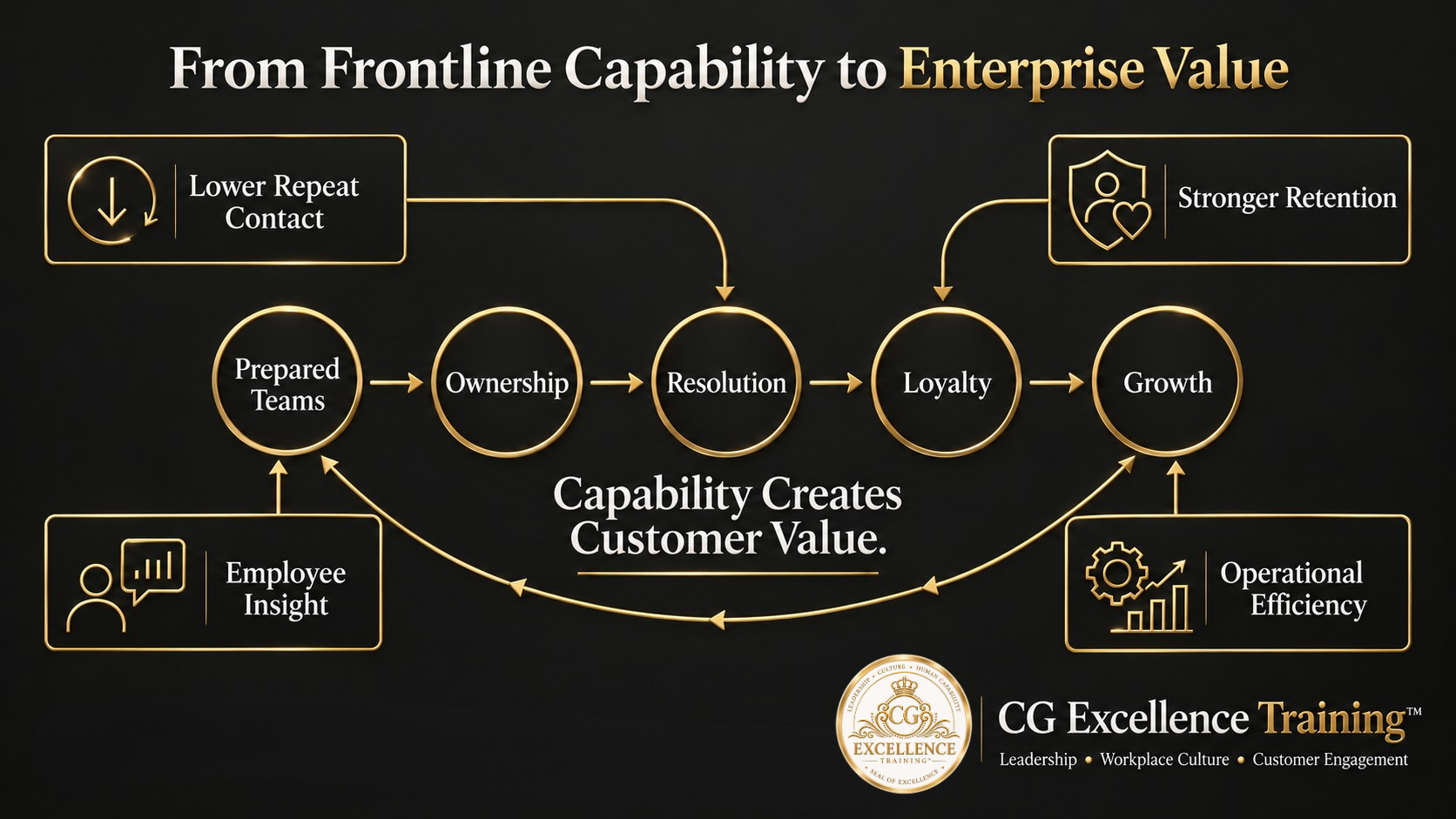
The CG Excellence Value Pathway: Prepared teams exercise ownership, create stronger resolution, build loyalty and contribute to growth. Employee insight returns to the organization as a source of continuous improvement.
Five Executive Questions for Recovering Value
Organizations ready to address the cost of indifference can begin with five questions:
Where does indifference appear? Examine listening, guidance, ownership, urgency, handoffs, recovery practices and follow-through across digital and human customer journeys.
Where does financial exposure emerge? Connect service gaps with reduced spending, attrition, repeat contact, labor demand, concessions, rework and missed opportunity.
Which underlying gap is present? Distinguish capability, activation and system conditions using input from employees, managers, operations leaders and customers.
Which behaviors receive consistent reinforcement? Review goals, scorecards, incentives, staffing models, manager routines, recognition practices and performance conversations.
Which improvement offers the greatest return? Prioritize development, coaching, decision authority, tools, workflow design, staffing alignment or accountability according to available evidence.
One direct question posed to frontline employees can open a valuable line of inquiry:
Which recurring customer problem could receive stronger support through clearer authority, focused preparation, improved tools or a more effective process?
Responses can reveal dormant expertise, recurring friction and practical opportunities already present within the workforce.
Customer Moments to Enterprise Value
Indifference becomes costly through scale. A delayed response, incomplete handoff or missed opportunity for ownership gathers significance through repetition. Over time, the organization experiences the combined effect through revenue movement, operating expense, workforce stability and reputation.
Leaders create the environment where service performance develops. Executive priorities, resource allocation, manager development, decision authority, workforce planning, performance measures and employee listening practices influence the quality of every customer experience.
The frontline serves two essential roles: a direct connection to customers and a rich source of enterprise intelligence. When organizations prepare employees, invite contribution, support sound discretion and improve the operating environment, dormant capability becomes measurable business value.
The cost of indifference reveals an opportunity to recover value already present among the people closest to the customer.
Move from Insight to Execution
CG Excellence Training™ guides organizations seeking stronger human capability, workplace culture and customer engagement. Customized recorded training resources and practical professional development tools support internal distribution, independent completion, manager-led development and enterprise-wide consistency.
The coordinating Leadership & Workplace Culture Workbook turns executive insight into a structured, measurable implementation process. Designed for CEOs, business owners, HR directors, managers and operational leaders, the workbook guides teams from general discussion into focused action.
The workbook provides a practical framework for:
Identifying recurring customer and employee experience patterns
Estimating financial exposure and value-recovery opportunities
Distinguishing capability, activation and system gaps
Gathering frontline insight through guided discussion prompts
Evaluating service handoffs, authority, workflow and support resources
Reviewing performance measures for alignment with customer outcomes
Developing a prioritized action plan with ownership and timelines
Building leadership accountability around culture, engagement and service performance
The Cost of Indifference Fillable Leadership & Workplace Culture Workbook provides a guided process for examining service exposure, estimating financial impact, identifying organizational gaps and building a focused 30-, 60- and 90-day value-recovery plan.
Access the Companion Workbook
Format: 23-page fillable PDF
Access: Immediate digital download.
Designed for: CEOs, business owners, HR Directors, managers and L&D leaders
Individual Participant License: $28
Purchasing for a leadership team?
The workbook is available for leadership teams and organizational use.
For 50 or more participants, multi-location distribution or expanded internal use, Contact CG Excellence Training™ and discover customized recorded training resources aligned with service priorities, workforce needs, leadership-development goals and organizational objectives.
Convert insight into measurable action.
Research Sources
The following research informed the customer-experience, employee-insight and organizational-performance perspectives presented in The Cost of Indifference:
$3 Trillion Is at Risk Due to Poor Customer Experiences in 2026
Qualtrics XM Institute, 2025
Global consumer research examining customer-experience quality, spending behavior and revenue exposure.The Loyalty Illusion: Why Companies Think They’re Winning When Customers Are Walking Away
PwC 2025 Customer Experience Survey
Research exploring customer loyalty, executive perception, human interaction and customer departure.Are Employee Ideas the Hidden Key to Operational Efficiency?
Eagle Hill Consulting Efficiency Survey, conducted by Ipsos, 2025
Findings examining employee insight, inefficient work, idea-sharing pathways and productivity improvement.The Relationship Between Engagement at Work and Organizational Outcomes
Gallup Q12 Meta-Analysis, 11th Edition, 2024
Analysis connecting employee engagement with customer loyalty, productivity, profitability, quality and workforce retention.
Thank you for your kind attention today. I hope these perspectives encourage a closer examination of where indifference may be creating hidden costs and inspire purposeful leadership action to strengthen employee contribution, customer relationships and enterprise value.
Christine