The Value of Human Capital
Organizational Value Through Human Contribution
Workforce cost is readily measured. Payroll, headcount, benefits, training expenditures and revenue per employee can be placed on a dashboard with clarity and consistency.
Human contribution creates value across a broader range of organizational outcomes. Knowledge protects continuity. Sound judgment supports responsible decisions. Trusted relationships strengthen customer confidence. Manager capability improves readiness and performance. Frontline insight reveals opportunities for stronger service, smoother processes and more meaningful customer connection.
Human capital includes the knowledge, capability, discretion, adaptability and relationship capital through which people create value. The concept extends beyond headcount, labor capacity, credentials, experience and output. Human capital reflects what people know, how they apply judgment, how they collaborate and how they contribute to the organization’s ability to perform.
For CEOs, business owners, HR Directors and senior leaders, human capital is an enterprise consideration. Workforce strategy influences what leaders preserve during periods of growth and change. It shapes which capabilities managers develop, which knowledge succession planning carries forward and which measures guide decisions about performance, resilience and readiness.
Organizations create lasting value when leaders understand the full contribution of their people and develop human capability with the same discipline applied to other strategic assets.
Recognizing Human Capital Value
Many organizations describe people as their greatest asset. Financial systems primarily reflect workforce expenses, while the operating value created through human knowledge, service judgment and relationships appears across many areas of the enterprise.
Human capital is distributed throughout the organization. An analyst may recognize a pattern that supports a timely decision. An experienced employee may provide guidance that accelerates a new hire’s progress. A manager may create the clarity and confidence a team needs during a major transition. A frontline employee may understand a customer’s true need before the customer has fully expressed it.
Value often appears through work that seems familiar or routine. Its significance becomes visible through customer confidence, smooth handoffs, sound decisions, timely problem resolution, consistent quality and effective collaboration.
A fuller human capital strategy begins with an important leadership question:
What do our people make possible for customers, colleagues and the enterprise?
The answer reaches beyond workforce cost and productivity alone. It reveals the knowledge, relationships, judgment and capability that support organizational performance.
The Scope of Human Capital
Human capital includes skills and competencies, while extending beyond a formal inventory of qualifications. It is an interconnected portfolio of individual and collective capability.
Institutional knowledge includes the history, context, operating experience and practical understanding developed over time. Employees often hold valuable knowledge about customers, processes, decisions, exceptions and organizational priorities.
Professional discretion reflects the ability to interpret circumstances and make responsible decisions when a policy, script or system offers only part of the answer.
Adaptability is the capacity to learn, transfer knowledge, respond to change and remain effective as conditions evolve.
Creative and problem-solving capacity supports process improvement, innovation, responsive service and thoughtful solutions to emerging needs.
Relationship capital includes the trust and understanding developed among employees, customers, partners and communities.
Cultural contribution appears through repeated behaviors that bring organizational values, service expectations, leadership standards and accountability into daily practice.
Each capability strengthens the others. Institutional knowledge supports professional discretion. Trust improves coordination. Manager capability influences whether learning becomes performance. Customer understanding informs stronger service, innovation and retention.
Together, these forms of human capital create organizational capability: the enterprise’s ability to execute, adapt, serve and continue creating value.
Put the Framework Into Practice
The Value of Human Capital Fillable Leadership Workbook helps leaders identify the capabilities their organization depends on, create visibility into institutional knowledge, strengthen continuity and turn insight into practical leadership action.
The 23-page fillable workbook includes a Human Capital Inventory, Knowledge Continuity Register, Professional Judgment Audit, AI Readiness Check, Customer Understanding Journal, Capability Metrics Worksheet and 30-, 60- and 90-day action plans.
Get Immediate Workbook Access — $28
Workplace Culture as Operating Capability
Workplace culture provides the environment through which human capital grows and becomes visible in performance.
Trust supports knowledge sharing. Accountability strengthens follow-through. Clear service expectations guide judgment in moments requiring discretion. Manager behavior influences whether employees build confidence, transfer learning and contribute their full capability. Communication creates clarity around priorities, standards and customer commitments.
Culture becomes operational through the ways people collaborate, make decisions, respond to change, resolve customer needs and carry organizational values into their work.
A workplace culture that supports learning, ownership, respect and service helps employees contribute more fully. Teams share expertise. Managers reinforce performance expectations. Employees develop the confidence to address needs early, communicate responsibly and bring forward improvement opportunities.
Human capital and workplace culture strengthen one another. Culture creates the conditions for people to apply their knowledge and judgment. Human capability brings culture to life through observable behavior, customer experiences and organizational results.
Protecting Institutional Knowledge
The retirement and transition of experienced employees bring attention to the difference between replacing a position and preserving capability. A role can be filled. The knowledge, customer insight and operating understanding connected with the role often require time and deliberate effort to transfer.
Deloitte reported that 92% of surveyed organizations do not consistently capture knowledge from employees approaching retirement. Valuable knowledge can include the history behind important decisions, trusted customer relationships, awareness of operating exceptions, informal networks and an ability to recognize emerging concerns early.
Knowledge continuity is a workforce-planning priority at every level where experience influences safety, quality, customer confidence, operational resilience or business continuity.
A knowledge-risk register can help leaders create visibility. The register may include:
Critical expertise and capabilities
Single-expert dependencies
Key customer, partner and internal relationships
Successor readiness
Knowledge-transfer opportunities
Estimated time required to rebuild a capability
Manager support required for continuity
The process brings institutional knowledge into workforce planning and enterprise risk management. Leaders gain a clearer view of where essential capability resides and how the organization can preserve it over time.
Technology and Human Capability
The rapid expansion of artificial intelligence increases the importance of human capability across the workforce.
The OECD’s 2026 AI and Skills synthesis found that fewer than 1% of workers are expected to require advanced AI-development skills. Across the broader workforce, data interpretation, managerial capability, problem-solving, creativity and innovation remain central to effective AI use.
The implication for leaders is significant. Enterprise AI strategy benefits from technical specialists, while value also depends on employees who can apply technology within the realities of the business.
AI can retrieve information, identify patterns and accelerate production. Employees and leaders provide context, judgment, accountability and responsible decision-making. They evaluate accuracy, determine relevance, recognize customer needs, understand operating priorities and guide appropriate next steps.
Technology can extend human capital by improving access to knowledge, supporting routine work and creating space for higher-value contribution. The greatest value emerges when employees have the confidence and capability to interpret, question and responsibly apply what technology produces.
Access to tools, time for learning and practical guidance are workforce-development decisions. Organizations can prepare a broader range of employees to contribute confidently in the next operating environment by building AI literacy, manager capability and opportunities for applied learning.
The Hidden Value of Customer Knowledge
Human capital lives at the point of customer contact.
Frontline employees develop valuable intellectual and relationship capital through daily interactions. They learn what customers misunderstand, what reassures them, which process steps create friction, which exceptions matter and what customers are trying to accomplish beyond the immediate request.
J.D. Power’s inaugural 2026 U.S. AI Insurance Experience Study illustrates an evolving customer experience. Customers are using AI to research coverage and make purchasing decisions, while many continue to value human support for claims, policy changes and customer-service needs.
As routine information becomes more accessible, human contribution becomes increasingly valuable through interpretation, reassurance, exception handling, relationship building and responsible resolution.
Service capability represents human capital in action. Employees create value when they listen for the need beneath the request, apply sound judgment, navigate exceptions, communicate with confidence and protect customer trust.
Service training builds more than communication skill. It develops practical capability. Employees learn how to represent organizational values, apply service standards, respond thoughtfully, strengthen relationships and create positive outcomes during important customer and colleague interactions.
Customer experience and employee capability are closely connected. Organizations can use frontline knowledge to improve processes, inform product and service decisions, strengthen customer relationships and support continuous improvement.
Measuring Human Contribution
Human capital measurement expands the evidence leaders use to understand how organizational value is created.
Traditional workforce metrics remain useful. Each metric can invite a capability-focused leadership question.
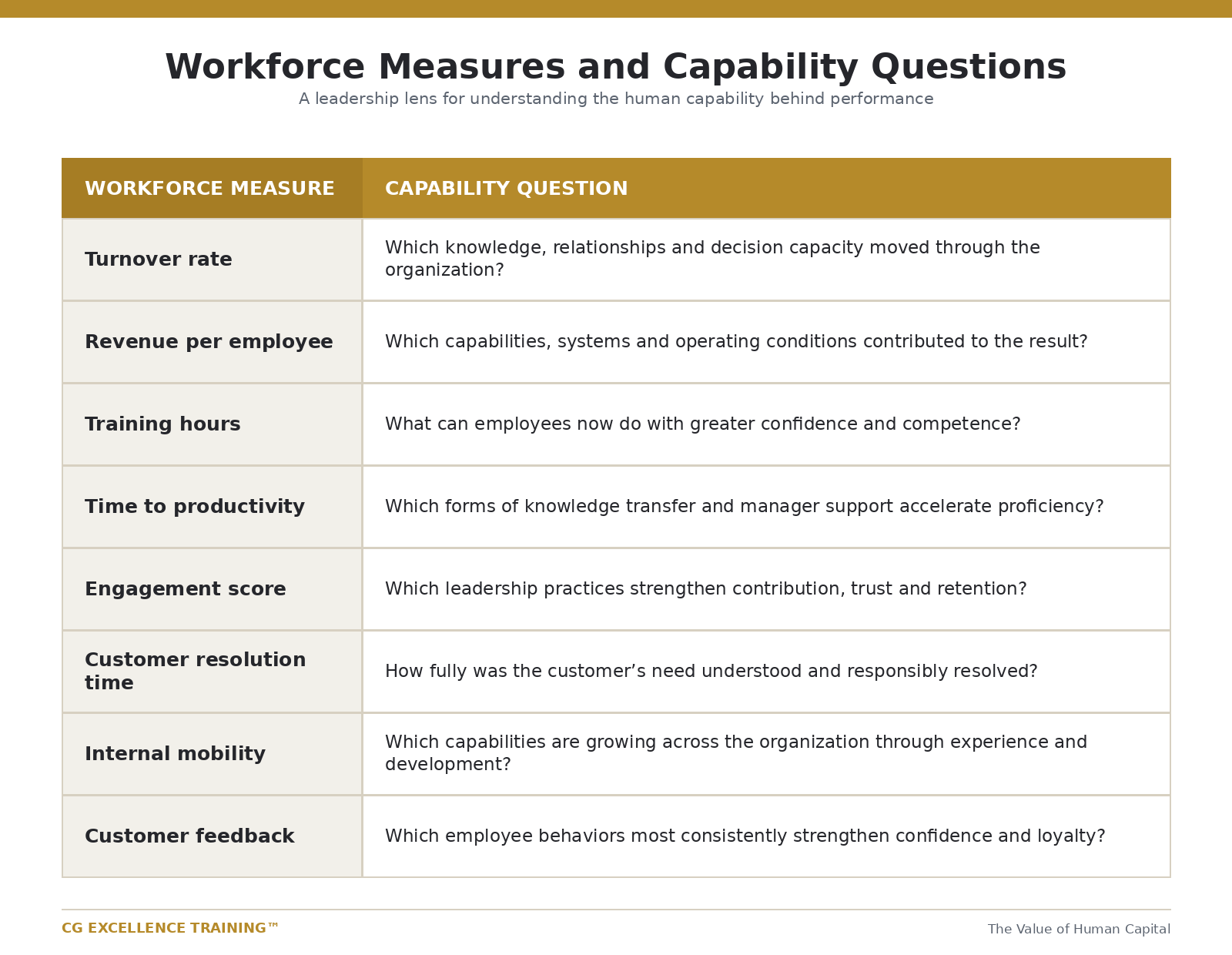
A mature human capital measurement system combines quantitative indicators with evidence of capability.
Skills demonstrations, customer narratives, employee language, manager behaviors, knowledge dependencies, service observations and internal mobility patterns reveal important dimensions of organizational strength. Leaders gain a more complete view of where capability resides, how it is developed and how it contributes to enterprise performance.
The purpose of measurement is stronger decision-making. Leaders can identify which capabilities drive results, where investment will create meaningful value and how organizational strength can grow over time.
Developing Human Capability
Recognizing human value invites thoughtful investment in development.
A recent review of 56 randomized U.S. worker-training studies found that average training offers produced modest gains in employment and earnings relative to program cost. Employer-connected sector programs produced stronger results in some settings, while outcomes varied across programs and contexts.
The findings reinforce an important leadership principle: expenditure and capability building represent different outcomes.
Training creates enterprise value when it connects with real work, relevant role requirements, manager practice, demonstrated competence and improved performance. Employees benefit when learning is practical, reinforced and supported through meaningful opportunities to apply new knowledge.
The same principle applies to technology, benefits and employee-experience initiatives. Resources become strategic investments when leaders connect them with the capabilities, behaviors and operating conditions the organization needs to perform.
A strong human capital strategy begins with clarity:
What does the organization need people to know?
Which decisions require stronger judgment and confidence?
Which service behaviors protect customer trust?
Which capabilities strengthen resilience and growth?
How will managers reinforce learning and performance?
Which measures will show progress over time?
Spending follows strategic clarity. Capability grows through deliberate leadership, practical development, consistent reinforcement and opportunities to apply learning in meaningful work.
Workforce Expense to Enterprise Asset
The future of work will continue to shape job design, task distribution, technology adoption and customer expectations. Human capability will remain central to organizational performance.
Leaders can prepare with four strategic questions:
Which human capabilities create differentiated value for our customers and enterprise?
Where do those capabilities and critical knowledge currently reside?
Which conditions influence the availability, continuity and development of those capabilities?
How are managers, systems and development investments strengthening capability over time?
For CEOs and business owners, the focus includes protecting enterprise value, customer confidence, continuity and strategic execution.
For HR Directors and people leaders, the focus includes building systems for knowledge transfer, succession readiness, manager capability, workforce measurement and development.
For managers, the focus includes creating daily conditions where employees can learn, contribute, share knowledge, exercise sound judgment and deliver consistent service.
Human capital connects workforce strategy, succession planning, leadership development, customer experience, workplace culture and operational resilience. Organizations grow stronger when knowledge, judgment, relationships and capability receive thoughtful attention and deliberate development.
Human capital is an operating asset and a leadership responsibility. What an organization understands about its people influences what it can preserve. What leaders develop influences what the organization can become. What the organization measures reveals what it has chosen to value.
Turn Human Capital Insight Into Leadership Action
The Value of Human Capital Fillable Leadership Workbook translates the article’s framework into a guided leadership process.
Use the workbook to:
Identify critical human capabilities and institutional knowledge
Create greater visibility into knowledge continuity and succession readiness
Clarify professional judgment and decision guidance
Capture customer insight from frontline experience
Connect workforce measures with the capabilities behind performance
Evaluate workforce investments through demonstrated capability and outcomes
Create a focused 30-, 60- and 90-day action plan
Format: 23-page fillable PDF
Access: Immediate digital download
Designed for: CEOs, business owners, HR Directors, managers and L&D leaders
Individual Participant License: $28
Purchasing for a leadership team?
The workbook is available for leadership teams and organizational use.
For 50 or more participants, multi-location distribution or expanded internal use, contact CG Excellence Training.
The value of human capital becomes actionable when leaders can see it clearly, develop it deliberately and strengthen the culture through which people contribute their best work.
Ready to identify, protect and develop what people make possible?
Explore CG Excellence Training’s Distinctive Specialties.
Contact CG Excellence Training to begin a conversation.
Research Sources
Deloitte Insights. “The $9 Trillion Knowledge Exodus: How Organizations Can Turn Baby Boomer Retirements Into Competitive Advantage.” June 18, 2026.
OECD. AI and Skills. June 5, 2026.
J.D. Power. 2026 U.S. AI Insurance Experience Study. August 27, 2026.
Anthropic Economic Research. Review of Evidence From Randomized U.S. Worker-Retraining Studies. August 12, 2026.
Thank you for your kind attention today. I hope these ideas support you in recognizing, protecting and developing the human capital that strengthens organizational capability and creates lasting value.
Christine